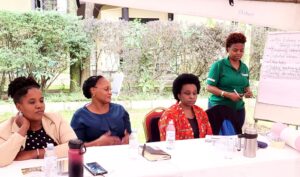
JINJA — Civil society organisations and child-rights advocates are calling on the Ugandan government to increase funding for the prevention and response to sexual violence against children, warning that laws and policies will have limited impact without adequate resources. The call was made during a three-day retreat in Jinja convened by World Vision Uganda in partnership with the Joining Forces Coalition, where more than 30 stakeholders discussed strategies for ensuring that sexual violence against children (SVAC) becomes a priority in the 2027/28 national budget.
The retreat brought together representatives from the Uganda Child Rights NGO Network (UCRNN), government, civil society organisations, cultural institutions including the Busoga and Buganda kingdoms, the Inter-Religious Council, economists, the Civil Society Budget Advocacy Group (CSBAG) and Makerere University. Participants said Uganda needs to move beyond developing policies and commitments and focus on implementation, financing, accountability and measurable action to protect children from sexual violence.
Opening the meeting, Irene Kagoya, Associate Director for Advocacy at World Vision Uganda, said sexual violence against children remains a serious concern despite efforts to address it. While available figures suggest some reduction in reported cases, she said sustained investment is still required to strengthen prevention and response systems. Kagoya urged stakeholders to use evidence and the forthcoming budget process to push for stronger government financing, asking how Uganda can move from policies and strategies to actual implementation and funding.
Cultural leaders also called for greater involvement of traditional institutions in protecting children. Dr Joyce Abaliwano, Minister for Gender and Children Affairs in the Busoga Kingdom, said cultural institutions have significant influence within communities and should be involved in designing interventions. She also highlighted concerns over teenage pregnancy, gender-based violence, defilement, parenting gaps and online risks facing children. Abaliwano urged stronger collaboration among cultural institutions, religious leaders, police, security agencies, government and the media to ensure that cases are properly handled and victims receive support and access to justice.
Emmanuel Omene, Principal Economist in the Planning Unit at the Ministry of Gender, Labour and Social Development, said government recognises SVAC as a major national concern requiring a coordinated response across homes, schools, communities and institutions. He cited statistics indicating that one in three girls and one in six boys in Uganda have experienced sexual abuse, while also warning that emerging threats such as online sexual exploitation require new approaches. Omene encouraged stakeholders to prepare a thematic issues paper outlining specific interventions that can be presented to government during the 2027/28 budget process and urged civil society to align its proposals with existing government programmes.
Participants said the next step should be to translate concerns and evidence into clearly funded programmes with measurable results. They proposed stronger coordination between government, civil society, cultural and religious institutions, the media and other child-protection actors, alongside greater accountability for institutions responsible for responding to abuse. The 2027/28 budget process, they said, provides an important opportunity to strengthen prevention, survivor support, access to justice and community awareness. The ultimate measure of progress, stakeholders argued, will be whether the national budget provides sufficient and targeted resources to protect children from sexual violence and ensure survivors receive the support they need.