


 National Women Council chairperson aspirant Irene Adokorach has called for a transparent, inclusive and level electoral playing field, urging the NRM Secretariat and the Electoral Commission to guarantee all candidates equitable access to delegates ahead of the national Women Council elections. Adokorach argues that a credible election must provide every aspirant with an equal opportunity to articulate their manifesto, engage voters and subject their leadership credentials to scrutiny, rather than allowing the contest to be influenced by restricted access or political advantage.
Drawing from her experience as a woman leader from northern Uganda, Adokorach said the National Women Council should remain an inclusive platform through which women from every region and community can participate in shaping the direction of women’s leadership. She congratulated candidates who prevailed in the district-level elections and encouraged those who lost not to regard electoral defeat as the termination of their political careers. According to her, the growing competitiveness of Women Council elections demonstrates that women are increasingly recognizing
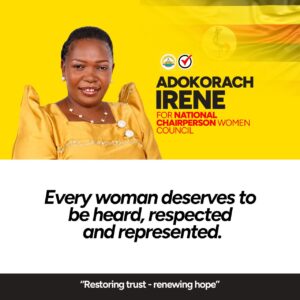 the strategic importance of the institution in national leadership.
Adokorach commended the outgoing Women Council leadership for elevating the visibility and institutional relevance of the council, but said her decision to seek the national chairperson position was driven by the conviction that more can be done to translate women’s leadership into tangible benefits at the grassroots. She emphasized that the council must become a stronger vehicle for articulating the concerns of ordinary women, particularly those in rural and underserved communities, arguing that national empowerment programmes should not remain concentrated in urban centres while millions of women in villages continue to face economic and social challenges.
A central pillar of Adokorach’s campaign is her emphasis on grassroots participation and locally responsive leadership. She contends that the question should no longer be whether Uganda is empowering women, but rather which women are benefiting from that empowerment and whether interventions are reaching communities where the need is greatest. Her proposed approach places greater emphasis on local content, community participation and ensuring that rural women—from Kiryandongo and Gulu to Mbarara and other parts of the country—are meaningfully represented in the national women’s agenda.
The aspirant has, however, raised serious concerns over what she describes as restrictions on candidates’ access to delegates during the ongoing electoral process. She alleges that some delegates have been inaccessible to aspirants, with some reportedly having their phones switched off, limiting opportunities for candidates to present their manifestos and engage directly with those expected to determine the outcome. Adokorach has therefore appealed to the NRM Secretariat and the Electoral Commission to clarify, enforce and publicly communicate the rules governing delegate access, arguing that democratic competition loses its credibility when candidates are prevented from freely reaching the electorate.
Beyond the question of delegate access, Adokorach has challenged the growing influence of financial power and political patronage in elective politics. She argues that leadership contests should be determined by competence, integrity, ideas, performance and the ability to respond to citizens’ concerns—not simply by the depth of a candidate’s financial resources or the strength of their political sponsors. She maintains that women without wealthy backers or influential “godfathers” should not be structurally disadvantaged, insisting that every aspirant deserves a legitimate platform from which to make their case before the electorate.
Adokorach has also appealed to President Yoweri Museveni to take note of the concerns raised by women aspirants and ensure that the electoral environment remains fair to all contestants. She further expressed appreciation to Hajjat Hadijah Namyalo for giving her opportunities to participate in NRM mobilisation activities, saying those experiences have strengthened her leadership capacity. As the race for the National Women Council chairperson position intensifies, Adokorach is positioning herself as a candidate focused on grassroots empowerment, inclusive participation and institutional reform, urging delegates to assess her candidature on the strength of her ideas and leadership agenda rather than financial muscle or political connections.
